

There are 283 million cars registered in the United States. While most drivers manage to use their vehicles without any serious issues, some experience car problems so severe that they result in recalls or even lawsuits.
This study will consider the issues that lead to recalls, the car brands most involved in recalls and lawsuits, and the laws in place to protect drivers. And with 92% of American households owning at least one vehicle, driver safety is a huge issue involving the vast majority of the U.S. population.
The U.S. Car Brands Subject To The Most Lawsuits
Despite ongoing technological and engineering improvements, by some measures, vehicles are less safe than they once were. Of those 283 million registered U.S. vehicles, tens of millions are recalled every year.
In 2022, automakers recalled around 29 million vehicles; that figure climbed to around 33.6 million in 2023 before dropping to 27.7 million in 2024.
The pattern has continued during 2025, with more than 3.4 million vehicles recalled in the first quarter, followed by 7.3 million in the second quarter: that’s a mid-year total of nearly 10.8 million so far.
Before the year’s end, the recall figure will be well north of 20 million cars, and will comprise somewhere around 10% of all cars on U.S. roads. To get an idea of the extent to which each state is affected, it’s worth looking at how many vehicles are registered in different parts of the country.
The States Featuring The Highest Number of Registered Vehicles In The U.S.
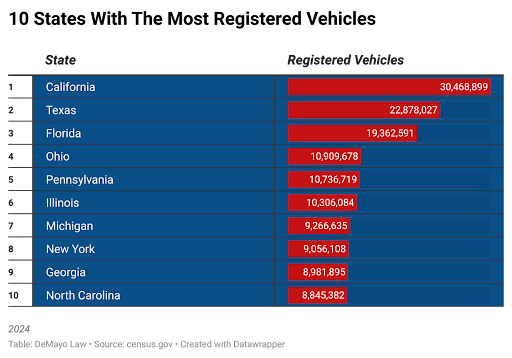
Simply put, a list of the ten states that feature the highest number of registered vehicles tells us where driving is most central to U.S. daily life. It also confirms that California features by far the nation’s highest number of registered vehicles (30.4 million), reflecting both its huge population and its car-centric culture.
Texas is next up (22.9 million registered vehicles), with Florida third (19.3 million), underscoring the heavy reliance on cars across the Sun Belt.
Cars also feature in huge numbers in the Midwest and Northeast, with Ohio, Pennsylvania, and Illinois each reporting over 10 million registered vehicles. Michigan, the traditional heart of the auto industry, has over 9.2 million vehicles on its roads, with New York, Georgia, and North Carolina (all featuring around 9 million registered vehicles) rounding out the top ten.
Combined, these ten states account for a massive share of U.S. vehicle registrations and feature regions where road infrastructure, traffic congestion, and vehicle-related policies are massively important to local residents. This is certainly true for us here in North Carolina.
Cars In North Carolina
NHTSA figures suggest that over 50 million vehicles are recalled in the U.S. every year: out of just over 280 million registered vehicles, that’s almost one in five cars, or around 18%.
If we apply that estimate to North Carolina’s 8.8 million registered vehicles, it means that around 1.7 million cars on average are affected by recalls or manufacturer defects every year.
Such recalls can involve a host of issues, including safety defects like faulty brakes or airbags, emissions-related problems, software glitches in newer model computer systems, and structural or mechanical failures. And vehicles (both old and new) recalled more than once during their life on the road compound the issue.
Let’s consider the main issues that lead to vehicle recalls in the United States.
Top 10 Vehicle Recall Issues
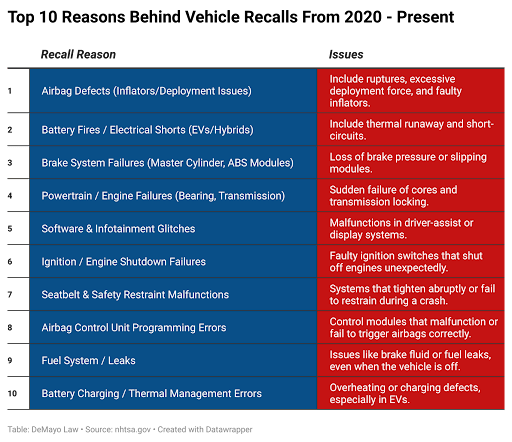
Since 2020, common reasons for U.S. vehicle recalls span both traditional mechanical and contemporary technology issues. At the top of the list are airbag defects, a long-running concern due to faulty inflators and control units.
Close behind when it comes to causing recalls are battery-related fires and charging issues, defects tied to the rapid growth of electric and hybrid vehicles.
Brake failures and engine or powertrain defects are also frequent reasons for recall, often causing sudden stalling in the latter case. Modern cars also feature a number of relatively new and unique risks, increasingly driven by software and infotainment glitches.
Other major issues include ignition switch failures, seatbelt malfunctions, airbag control programming errors, and fuel system leaks, all of which can present serious safety hazards. Combined, these top ten causes illustrate how modern-day vehicle recalls are a mix of longstanding, recurring safety issues and contemporary problems regarding electric vehicle-related and software-heavy factors.
So, we’ve seen which kinds of problems afflict the cars on our roads. But which car brands are most susceptible to these issues?
Top 10 Recalled Car Brands
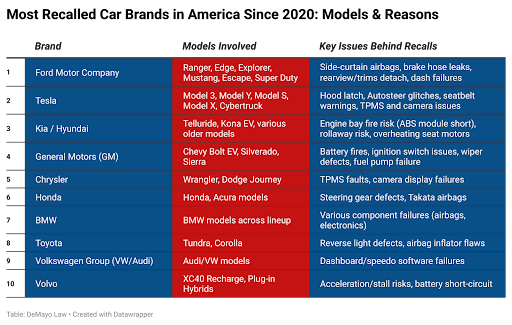
Between 2020 and 2025, millions of vehicles across the U.S. were recalled, with many automakers repeatedly flagged for serious safety and performance issues. Ford was the biggest culprit, with over 17 million vehicles recalled due to problems like brake master cylinder failures, faulty transmissions, and SUV/hybrid fire risks.
General Motors (Chevy, GMC, Cadillac) issued the next-highest number of recalls for things like engine failures, ignition defects, and electrical system vulnerabilities. The models affected include the Silverado, Sierra, and Bolt EV.
Chrysler (Dodge, Jeep, Ram) features highly on the recalls list due to significant numbers of airbag deployment issues, emissions control defects, and sliding door malfunctions.
Hyundai and Kia issued major recalls due to engine fire risks, airbag control unit failures, and ABS malfunctions, particularly among models like the Elantra, Palisade, and Telluride.
BMW, Nissan, Toyota, Honda, Volkswagen, and Tesla also feature on the recalls list, due to problems that range from component failures, battery fires, seat belt malfunctions, and phantom braking, to software bugs and defective airbags. The wide variety of reasons for issuing recalls highlights both the enduring blight of legacy mechanical problems and the work-in-progress nature of cutting-edge car tech.
While some brands take far too long to fix their safety issues, others move swiftly. Tesla, despite frequent adverse headlines, has issued over-the-air software updates within days of identifying bugs, making its recall response time among the fastest for digital defects.
Honda and Toyota are known for relatively fast turnarounds when it comes to fixing physical part issues, such as seatbelt or brake recalls, often reaching a 70–80% repair rate within six months.
Conversely, brands like Ford and GM, both of which deal with a disproportionate number of mechanical issues, often need extended time periods in which they can ship parts or schedule dealer repairs, extending driver risk and NHTSA scrutiny. The speed of a carmaker’s response isn’t just a matter of compliance—it’s a test of brand integrity and customer care.
And what about the matter of ‘zombie recalls’? A recall is only useful to a car owner if it leads to a repair: across the U.S., millions of cars remain on the road with unresolved critical defects.
These so-called ‘zombie recalls’ are most prevalent in states featuring older vehicle fleets and low compliance rates. For example, states like Texas, Florida, and North Carolina, each with over 8 million registered vehicles, could potentially feature 1.5 million ‘zombie recalls’ on their highways.
Many drivers are never aware of such defects, or they may ignore any recall alerts. The most common unresolved ‘zombie’ issues include faulty airbags, inadequate braking systems, and engine defects. These ‘zombie’ cars pose a hidden danger not just to their drivers, but to other drivers sharing the same roads.
Ultimately, whatever the reason for a recall, it’s nice to be covered legally for any issues that arise.
Lemon Laws and Class Action Lawsuits
When you buy a new or certified used car, the last thing you need is an issue that forces you to spend more time in the repair shop than on the road. In such cases, lemon laws apply.
Lemon laws are state and federal protections. They ensure that, if your vehicle is under warranty and suffers from persistent issues that the manufacturer can’t quickly fix, you may be entitled to a replacement or refund.
North Carolina Lemon Law
North Carolina’s Lemon Law (New Motor Vehicles Warranties Act) protects buyers of new cars, trucks, vans, and motorcycles. It obliges car manufacturers to fix defects that affect a vehicle’s use, safety, or value within the first 24 months or 24,000 miles. For a car owner to qualify, the issue must be covered under warranty, reported in writing, and must remain unresolved after either four repair attempts or 20 business days in the shop within 12 months.
If the defect still isn’t fixed after those attempts or within that timeframe, a car owner can choose an equivalent replacement vehicle or claim a refund (including taxes, fees, and finance charges, minus a mileage deduction).
When the problem is a matter of thousands of cars as opposed to just one, that’s when we enter the realm of the class action lawsuit.
Class action lawsuits allow groups of frustrated drivers to join forces to take legal action against automakers regarding widespread car defects.
While lemon laws protect individual buyers, class action suits hold manufacturers accountable on a much larger scale. This is especially true if a defect negatively affects safety, value, or performance across an entire model lineup.
Together, lemon laws and class action lawsuits represent a powerful one-two punch on behalf of consumer road rights, with the following group of car brands subject to a disproportionate number of class action lawsuits.
Top 10 Car Brands Involved In Class Action Lawsuits
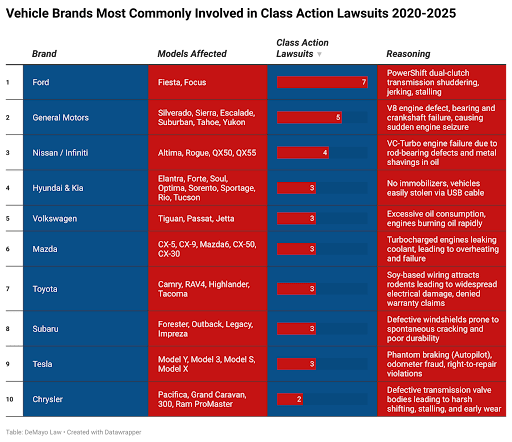
From 2020 to 2025, several major automakers were the focus of large-scale class-action lawsuits regarding recurring vehicle defects. The issues in question ranged from engine failures to design oversights that compromised safety.
General Motors faced one of the most extensive lawsuits, which involved over 877,000 trucks and SUVs. The issue at the center of the lawsuit related to defective V8 engines prone to sudden failure.
Nissan and Infiniti were hit similarly hard due to a critical VC-Turbo engine flaw, which caused widespread engine breakdowns in nearly half a million vehicles, and led to a significant class action lawsuit.
Hyundai and Kia drew unwanted legal attention when it was revealed that many of their models lacked basic theft protection. This design oversight triggered mass car thefts and culminated in a $200 million settlement.
Ford’s problematic PowerShift transmission led to costly action. While brands such as Mazda, Subaru, Toyota, Volkswagen, and Chrysler were subject to significant lawsuits, issues included coolant leaks, brittle windshields, rodents snacking on soy-based wiring, and faulty valve bodies.
Tesla was notable as the subject of a wide variety of complaints, including phantom braking and disputes related to the odometer warranty.
Though the number of affected vehicles wasn’t always disclosed in each case, it’s clear that legal pressure on automakers is growing as consumers demand accountability for defects hampering reliability, safety, and long-term vehicle performance. And it’s often (perhaps unsurprisingly) true that brands susceptible to significant recalls are also subject to lawsuits.
Recalls vs Lawsuits
When we consider those brands most often tied to recalls alongside those facing the most class-action lawsuits, there’s significant overlap, with GM, Ford, Tesla, Hyundai/Kia, Toyota, Volkswagen, and Chrysler prominent on both lists.
This illustrates a clear pattern of large-scale recalls that often result in legal action when fixes are delayed, inadequate, or costly to consumers. Recalls usually stem from regulatory pressure to address safety risks or defects; subsequent lawsuits often arise when drivers successfully argue that those defects caused financial loss or were not properly resolved.
Brands like Mazda, Subaru, and Nissan tend to be subject to more lawsuits than recalls, suggesting limited but serious defects. On the other hand, Honda, BMW, and Volvo are far more involved with recalls than lawsuits, reflecting their proactive willingness to solve issues and avoid courtroom conflict.
Overall, repeat recalls frequently escalate and result in lawsuits. As for the brands that appear on both lists, they face significant pressure to rebuild consumer trust.
Summary
Vehicle ownership is close to universal in the U.S., with 92% of households owning at least one car and more than 283 million vehicles registered.
While cars remain essential assets, safety issues are widespread, with recalls affecting tens of millions of vehicles every year. The states with the most vehicles (California, followed by Texas and Florida) feature the highest number of affected drivers, while states like Michigan, New York, Georgia, and North Carolina also see millions of annual recalls.
The main causes of recalls include airbag defects, brake failures, engine and transmission issues, plus more contemporary risks such as battery fires and software glitches. Brands such as Mazda, Subaru, and Nissan face more lawsuits than recalls, while Honda, BMW, and Volvo suffer more recalls than lawsuits.
Lemon laws ensure that, if your vehicle is under warranty and suffers from persistent issues that the manufacturer can’t quickly fix, you may be entitled to a replacement or refund
Whereas brands like Ford, GM, Hyundai/Kia, and Tesla notably appear frequently on both recall and lawsuit lists, emphasizing how unresolved problems often easily evolve into costly legal battles. Any such overlap regarding recalls and lawsuits underscores the growing pressure on automakers to address both traditional mechanical flaws and the evolving risks of modern, tech-heavy vehicles.
Ultimately, car owners are often protected by lemon laws, which safeguard drivers unlucky enough to be lumbered with faulty cars. When problems are a matter of fleets and models as opposed to single vehicles, class action lawsuits mean groups of car owners can push for accountability on a larger scale.
For carmakers, getting things right at the production level can help them avoid costly lawsuits and lost sales. But dealing with issues quickly and effectively as they arise is just as important. By doing so, carmakers can both preserve brand reputation and keep drivers on the road and out of both the garage and the courtroom.
Here at DeMayo Law Offices, we’re the personal injury law firm that’s protected our clients since 1992; the results are over a billion dollars in settlements and verdicts for our clients and their families.
Our experience and results make all the difference. It will cost you nothing to get a free case evaluation today, so get in touch.
